

The Complete Beginner's Guide to EMT Training Programs
Updated: Jul 29
If you've ever considered becoming an Emergency Medical Technician (EMT), you've probably wondered where to start. What exactly does EMT training involve? How long does it take? Do you need prior medical experience? And perhaps most importantly—can you actually do it?
The good news is that EMT programs are designed to teach beginners the knowledge and skills needed to provide emergency medical care. Whether you're exploring a career in emergency services, planning to become a firefighter, considering a future in healthcare, or simply looking for meaningful work that makes a difference, understanding how EMT training programs work is the first step.
This beginner's guide will walk you through everything you need to know about EMT training programs, what to expect, how to prepare, and how to position yourself for success.
What Is an EMT?

An Emergency Medical Technician is a healthcare professional trained to provide emergency medical care outside of the hospital setting.
EMTs are often among the first healthcare providers to arrive during emergencies. They assess patients, provide life-saving interventions, and transport individuals safely to medical facilities when necessary.
EMTs commonly work in:
Ambulance services
Fire departments
Emergency response agencies
Hospitals
Industrial settings
Event medical services
While the job can be physically and emotionally demanding, it is also one of the most rewarding careers for individuals passionate about helping others.
What Is an EMT Training Program?

An EMT training program is an educational course designed to prepare students for entry-level emergency medical practice.
These programs combine classroom instruction, hands-on skills training, scenario-based learning, and, in some cases, clinical experiences or ambulance ride-alongs.
Students learn how to recognize medical emergencies, perform patient assessments, and provide appropriate prehospital care.
Upon successful completion, graduates may become eligible to pursue certification examinations required within their state or region.
Do You Need Medical Experience Before Enrolling?

One of the biggest misconceptions about EMT school is that you need a healthcare background before starting.
You don't.
Most EMT programs are specifically designed for beginners.
Students often come from diverse backgrounds, including:
Recent high school graduates
College students
Military personnel
Career changers
Firefighter candidates
Individuals pursuing healthcare careers
The curriculum assumes students are learning these concepts for the first time.
However, preparing beforehand can make the transition much smoother.
Our EMT Study Roadmap provides helpful guidance for students wondering what they should review before classes begin:
What Topics Are Covered in EMT Training?

EMT programs cover a wide range of emergency medical topics.
Common subjects include:
Patient Assessment
Students learn systematic approaches to identifying life-threatening conditions and gathering important patient information.
Airway Management
You'll practice maintaining open airways and assisting patients experiencing respiratory distress.
CPR and Resuscitation
Cardiopulmonary resuscitation remains one of the most essential skills taught during EMT education.
Trauma Care
Students learn how to recognize and manage injuries involving:
Bleeding
Fractures
Head injuries
Spinal trauma
Shock
Medical Emergencies
Training also focuses on conditions such as:
Heart attacks
Stroke
Seizures
Diabetic emergencies
Allergic reactions
Special Populations
Students explore considerations related to caring for:
Pediatric patients
Older adults
Pregnant patients
Individuals with special healthcare needs
How Long Does EMT Training Take?

The length of EMT programs varies depending on the institution and schedule format.
Some programs operate on accelerated timelines, while others follow traditional semester structures.
Factors affecting program duration include:
Class frequency
Clinical requirements
State regulations
Institutional policies
Regardless of the format, students should expect a significant time commitment both inside and outside the classroom.
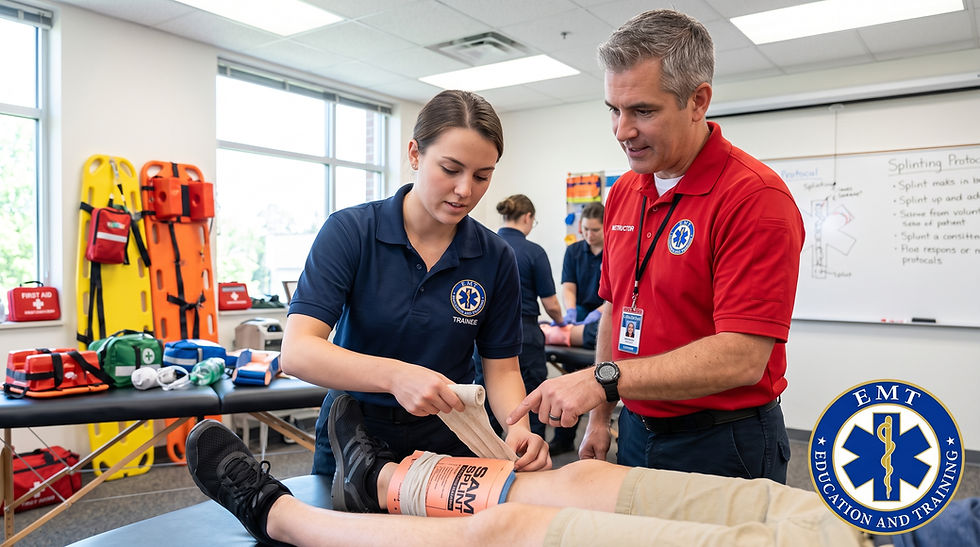
What Happens During EMT Skills Labs?

EMT education isn't limited to lectures and textbooks.
Skills labs provide opportunities for students to practice procedures repeatedly under instructor supervision.
Common skills include:
Taking vital signs
CPR performance
Bleeding control
Splinting fractures
Oxygen administration
Patient lifting and moving techniques
Medical assessments
Trauma assessments
These hands-on experiences help bridge the gap between theoretical knowledge and real-world application.
Expect Scenario-Based Learning
One of the most engaging aspects of EMT education involves simulated emergency scenarios.
Instructors create realistic patient situations requiring students to apply their knowledge under pressure.
Scenarios might involve:
Chest pain patients
Motor vehicle accidents
Pediatric emergencies
Respiratory distress
Unresponsive individuals
These exercises build confidence while strengthening communication and critical thinking skills.
Anatomy and Physiology Matter More Than You Think
Many students underestimate the importance of understanding how the human body functions.
However, anatomy and physiology help EMTs recognize abnormal findings and understand why patients experience certain symptoms.
This knowledge supports:
Accurate patient assessments
Better decision-making
Improved exam performance
Stronger clinical reasoning
Developing a solid understanding of body systems early in your education can improve your overall learning experience.
EMT School Requires Studying Outside of Class
Success in EMT school depends heavily on what happens after lectures end.
Students should expect regular assignments, reading requirements, and independent study sessions.
Helpful study habits include:
Reviewing notes daily
Using flashcards
Participating in study groups
Practicing EMT-style questions regularly
Students who prepare consistently often report lower stress levels during examination periods.
Our article on common mistakes students make before EMT school begins explains why early preparation matters:
What About EMT Exams?
Written examinations evaluate your ability to apply knowledge rather than simply memorize facts.
Questions often require critical thinking and prioritization.
Students preparing for EMT examinations frequently benefit from exposure to realistic practice questions.
If you're looking to strengthen your test-taking skills, explore these free EMT practice questions with detailed explanations:
Practice can improve both confidence and performance.
Understanding the National Registry Examination
Many EMT graduates pursue certification through the National Registry process.
Students often wonder whether practice questions accurately reflect the real testing experience.
Understanding what to expect can reduce anxiety and improve preparation strategies.
This guide comparing EMT practice tests versus the actual EMT examination provides helpful insight:
Knowing how questions are structured helps students approach certification more confidently.
Clinical Experiences and Ride-Alongs
Depending on program requirements, students may participate in clinical observations or ambulance ride-alongs.
These experiences provide opportunities to witness emergency medicine firsthand.
Students often gain valuable exposure to:
Patient interactions
Documentation practices
Emergency department operations
EMS teamwork
Field decision-making
For many students, these experiences reinforce their passion for emergency medicine.
What Qualities Help Students Succeed?
While academic ability certainly matters, successful EMT students often share similar characteristics.
These include:
Strong Work Ethic
EMT programs require dedication and consistency.
Adaptability
Emergencies rarely unfold exactly as expected.
Compassion
Patients remember how healthcare providers make them feel.
Communication Skills
Effective teamwork improves patient outcomes.
Resilience
Learning to manage stress supports long-term success.
None of these qualities require perfection.
They develop through experience and intentional effort.
Is EMT Training Worth It?
Only you can answer that question.
However, many EMTs describe their careers as deeply meaningful.
EMTs have opportunities to:
Help people during crises
Serve their communities
Build lifelong skills
Explore healthcare careers
Pursue advancement opportunities
Although the path involves hard work, many find the rewards worthwhile.
Additional Preparation Can Make a Difference
Students who enter EMT school feeling prepared often experience greater confidence.
If you'd like additional support before or during your EMT education, EMT Eat's self-paced preparation resources were designed specifically for future EMS professionals.
Learn more about the EMT Prep Course here:
Structured preparation may help strengthen foundational knowledge while reducing unnecessary stress.
Frequently Asked Questions
Can I become an EMT without healthcare experience?
Yes. Most EMT programs are designed for beginners with little or no prior medical background.
How difficult is EMT school?
EMT school can be challenging because of its fast pace and extensive material. However, preparation and consistent studying significantly improve success rates.
What should I study before EMT school starts?
Many students benefit from reviewing anatomy basics, medical terminology, and patient assessment concepts.
Are practice questions helpful?
Absolutely. Practice questions reinforce knowledge while helping students become familiar with EMT-style testing.
Will I receive hands-on training?
Yes. Skills labs and simulation scenarios are major components of EMT education.
Can EMT training lead to other healthcare careers?
Yes. Many individuals use EMT certification as a stepping stone toward careers in paramedicine, nursing, firefighting, physician assistant studies, and other healthcare professions.
Take the First Step Toward Your EMT Career
Beginning your EMT journey can feel overwhelming, but every experienced EMS provider once stood exactly where you are now.
The key isn't knowing everything before you start.
It's being willing to learn, practice consistently, and remain committed to growth throughout the process.
Whether you're preparing for your first EMT class or exploring whether emergency medicine is the right fit, EMT Eat provides resources designed to support your success.
From study guides and realistic practice questions to structured preparation programs, you'll find tools that can help you build confidence and strengthen your foundation before exam day arrives.
Visit EMT Education and Training today and take the first step toward becoming the EMT you've always wanted to be.


Comments