

What to Expect During Your EMT Training Course: A Beginner's Guide to EMT School Success
Updated: Jul 17
Starting an EMT training course can feel exciting, overwhelming, and intimidating all at once. Many aspiring EMT students wonder if they are smart enough, physically capable, or emotionally prepared for the demands of EMS.
If that’s you don’t worry, you are not alone. Many prospective EMT students have the same doubts.
Whether you're working toward a dream of working in emergency medicine, preparing for a career as a paramedic or firefighter, or just looking for a profession where you can feel like you’re making a difference, understanding what lies ahead can help erase your anxiety and set you up for success.
If you're planning to enroll in an EMT school soon, here's some of what you can expect during your course.
EMT Training Course Expectations: Why EMT School Moves Fast

One of the big surprises for students is how quickly the EMT program moves. There are many EMT Courses taught in colleges or Universities that stretch over several months, but even these courses tend to have more high-pressure evaluations and cover much more material than most students have had to experience in their past education. EMT classes often cover large amounts of material in a relatively short timeframe.
One of the things you can do is prepare ahead of time.
If you're waiting for your EMT class to begin, take some time to get familiar with the materials and key concepts beforehand. This will boost your confidence, reduce your stress, and improve your results. Check out our guide on how to prepare before EMT school starts. It provides a practical study roadmap to help you build a strong foundation before stepping into the classroom:
Students who are well prepared tend to adapt more quickly to the pace of EMT training.
Your First Day of EMT Class

Your first day will likely focus on orientation and introductions.
You'll meet your instructors, receive your course syllabus, and learn about important program requirements. Topics may include attendance policies, clinical rotations, skills testing procedures, and certification expectations.
You may also receive:
Course textbooks or online learning access
Uniform requirements
Skills lab schedules
Information about state or National Registry testing
Assignment deadlines
The first day often feels less intense than many students anticipate, but don't let that fool you. The pace usually picks up quickly after orientation.
Expect to Learn More Than Basic First Aid

Don’t make the mistake of thinking EMT courses are basically advanced first aid classes.
EMT training covers a broad range of emergency medical topics designed to prepare students for real-life emergencies.
Throughout your training, you'll study:
Patient Assessment
Learning how to identify life-threatening conditions quickly is one of the most important responsibilities of an EMT.
You'll be taught how to perform systematic patient assessments, gather information efficiently, and prioritize care appropriately.
Airway and Breathing Emergencies
Maintaining adequate oxygen levels in your patients saves lives.
You'll be taught to be proficient in:
Oxygen administration
Airway adjuncts (tools)
Bandaging and splinting
Dealing with medical and traumatic emergencies like:
Diabetic emergencies
Cardiac emergencies
Respiratory emergencies
Major and minor trauma care
And much more…
Trauma Management
Trauma care is a big partt of EMT training.
You'll need to learn how to manage injuries of various types:
Motor vehicle accidents
Falls
Penetrating trauma
Fractures
Head injuries
Medical Emergencies
Not every EMS call involves trauma, in fact, most don’t. Most “emergency” calls are the result of various “medical” problems.
You'll learn how to recognize and treat patients suffering from:
Heart attacks
Strokes
Drug overdoses
Seizures
Allergic reactions
Respiratory distress
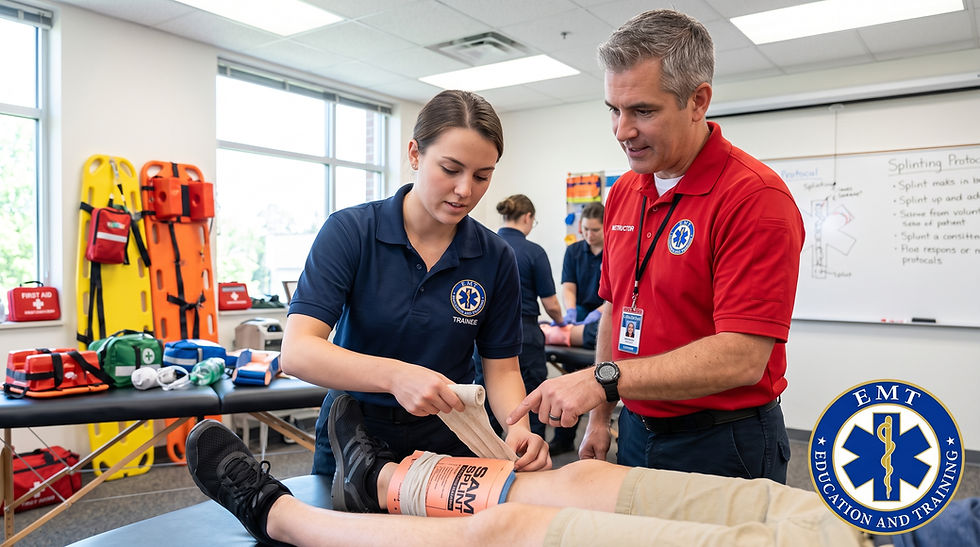
Hands-On Skill Training Will Be Part of Your Routine

One of the most rewarding aspects of EMT school is learning the skills that can directly impact patient outcomes.
EMT school is not like classroom environments, EMT emphasizes doing, not just memorizing.
Expect to spend a lot of time both in class, and outside class, practicing skills such as:
CPR
AED use
Bleeding control
Splinting techniques
Taking vital signs
Patient moving procedures
Medical assessments
Trauma assessments
Initially, these skills will feel awkward and you will make lots of mistakes, but here is one of the biggest tips I can give you: REPITITION, REPITITION, REPITITION! You must keep practicing the same skills over and over and over until you begin to develop some “muscle memory.” This will help to ensure that you will perform your skills correctly when you’re nervous… like during testing and when treating actual real world patients once you graduate.
Nobody walks into EMT school already knowing how to perform these procedures perfectly and no one ever failed their Practical Final because they practiced “too much.”
Scenario Training Helps Prepare You for Real Emergencies

It’s typical for EMT instructors to use simulated emergency scenarios to help you understand and apply concepts learned in class.
During these scenarios, students will be required to apply their knowledge in realistic situations involving patients with a variety of different conditions.
Some of the common scenarios involve:
Chest pain patients
Asthma attacks
Car accident victims
Unresponsive individuals
Pediatric emergencies
The simulations teach students how to remain calm under pressure, how to improve critical thinking and communication skills, and how to provide the proper care for the patient.
There Will Be More Studying Than You Expect

EMT programs require dedication inside and outside the classroom.
You will be given reading assignments, quizzes, skills practice, and you will also have to keep up with attending class, lab, and reviewing your lecture notes. This all needs to become part of your weekly routine.
Don’t make the mistake of underestimating the importance of consistent studying.
Trying to memorize everything the night before an exam rarely produces positive results and in the rare case when they do, what you learned is quickly forgotten. This doesn't work in EMT school.
Successful EMT students typically:
Study in shorter, regular sessions
Review and rewrite their notes after each lecture
Form study groups
Create and use practice questions frequently
If you want to strengthen your preparation, our article on why preparing before day one matters offers valuable insight:
The above link takes them to one of the “negative” blog posts we are trying to move away from. Can we make a better one or eliminate that link altogether please?
Make Sure To Be Ready For EMT Exams
Written examinations assess your understanding of emergency medicine concepts and your GTo
To do well you will have to apply critical thinking skills, simple memorization won’t do it.
You will need to determine:
Which patient requires immediate attention
What intervention takes priority
How to apply treatment protocols appropriately
Practicing EMT-style questions early can help familiarize you with the testing format.
For additional preparation, explore our collection of free EMT practice questions with answer explanations.
Understanding how questions are structured will help a lot with your performance and good performance is how you build confidence.
You Will Feel Stressed During Skills Testing
At various points throughout your course, instructors will evaluate your ability to perform specific psychomotor skills.
These practical exams often involve:
Trauma assessments
Medical assessments
CPR
Airway management
Bleeding control
Any many other skills
You’re going to feel stressed but that is good, real world calls are often stressful too. Your instructors want you to succeed but they don’t want you going out unprepared and hurting someone. Here is another helpful tip:
BE TRAINABLE!!!
You’re going to mess up, that’s totally normal. Don’t make excuses and let your feelings get hurt when you mess up and your instructor corrects you: reset and run it again, and again, and again.
Practice remains the key to success. As you get better at your performance your nervousness will go down.
Clinical Experiences Offer Valuable Perspective
Depending on program requirements, you may participate in ambulance ride-alongs or clinical rotations.
These experiences allow students to observe EMS professionals in real healthcare settings.
You'll gain exposure to:
Patient interactions
Documentation procedures
Emergency department operations
Team communication
Real-world decision-making
Many students report that clinical experiences reinforce why they chose EMS in the first place.
EMT School Tests Your Emotional Resilience Too
Emergency medicine involves more than technical knowledge.
You may encounter discussions involving severe injuries, critical illnesses, and emotionally difficult situations.
Developing healthy coping strategies becomes important not only during training but throughout your future career.
Remember:
Feeling nervous is normal, don’t let it mess you up.
Feeling challenged doesn't mean you don't belong - keep at it and you will be fine.
Get comfortable outside your comfort zone. This is how you will grow and improve.
Preparing for the National Registry Exam
As graduation approaches, students typically shift their focus toward certification preparation.
Many future EMTs wonder how closely practice exams resemble the actual certification process.
Understanding these differences beforehand can help reduce test anxiety.
Our article comparing EMT practice tests with the real EMT exam explains what students should expect.
The more familiar you become with the examination process, the more confident you'll feel when test day arrives.
Investing in Your Success Before EMT School Starts
While many students wait until classes begin to start studying, pre course preparation will give you a significant advantage.
Get a head start learning basic medical terminology, human anatomy and physiology, and some EMS fundamentals before your full EMT course begins. The more you know before your full EMT course starts, the less you have to learn AFTER your class starts.
If you want this head start check out our Online EMT Prep Course. It’s designed to prepare you for EMT training in any school in the nation. It’s online and self-paced so you can start any time.
Learn more here:
Tips for Succeeding During Your EMT Course
Stay Organized
Use calendars, planners, or apps to track assignments, exams, and skills deadlines.
Practice Skills Frequently
Repetition helps transform uncertainty into confidence.
Ask Questions Early
Clarify confusing concepts before they become larger obstacles.
Find Study Partners
Studying with classmates can improve accountability and understanding.
Take Care of Yourself
Adequate sleep, proper nutrition, and stress management support academic performance.
Remember Why You Started
Whether your goal is helping others, becoming a firefighter, entering healthcare, or advancing toward paramedic school, reconnecting with your purpose can help sustain motivation during challenging periods.
Frequently Asked Questions
How do I prepare for EMT school?
The best way to prepare for EMT school is to get familiar with medical terminology, basic anatomy, and how to study effectively before class starts. Students who spend even a few weeks reviewing these areas ahead of time report feeling less overwhelmed during the first unit, since EMT programs move fast and build on material quickly. A structured pre-course, like our EMT Prep Course, is built specifically to cover this ground before training starts.
What should I study before EMT class starts?
Focus on three areas before your first day: basic anatomy and body systems, common medical terminology, and how to read and interpret vital signs. You don't need to master these topics, just get comfortable enough that they're not brand new when your instructor introduces them. Reviewing a body systems overview and a medical terminology glossary is enough to start.
What is EMT school actually like?
EMT school is fast-paced, hands-on, and heavier on memorization than most students expect. Classes combine lecture time with skills practice, like patient assessment, splinting, and airway management, and most programs test both written knowledge and practical skills before certification. Depending on the course format, you'll spend anywhere from a few weeks to a full semester in class, with regular quizzes along the way.
How long does EMT school take?
EMT school length depends on the course format. An accelerated course can be completed in a matter of weeks with full-day sessions several times a week, while a standard or hybrid course spread across evenings or weekends can take a full semester. Our Accelerated EMT Course runs Monday, Wednesday, and Friday from 8am to 3pm for students who want to finish quickly and get into the field.
Is EMT school hard for beginners with no medical background?
EMT school is manageable for beginners, but it does require consistent study habits since the material moves quickly. Students with no prior medical background succeed regularly, the key is staying ahead of the material rather than trying to catch up after falling behind. Building a study routine before class starts makes a bigger difference than any prior medical knowledge.
What topics are covered in EMT school?
EMT programs generally cover patient assessment, airway management, trauma care, medical emergencies, pharmacology basics, CPR and AED use, splinting and bandaging, and ambulance operations. Most courses also include ride-along or clinical hours to apply these skills in real settings. Our EMT Prep Course breaks down 18 of these subject areas in advance, with a video and downloadable materials for each.
Do I need to study medical terminology before EMT school?
You don't need to be fluent in medical terminology, but a working knowledge of common terms helps you keep pace with lectures instead of spending class time looking words up. Terms related to anatomy, injuries, and vital signs come up constantly from day one.
Is EMT school physically demanding?
Yes, EMT training includes physical skills practice like lifting, carrying, kneeling, and performing CPR, so a reasonable level of physical fitness helps. You don't need to be an athlete, but you should be comfortable with hands-on, physically active learning.
What should I bring on the first day of EMT school?
Most programs expect students to bring a stethoscope, a watch with a second hand, a notebook, and comfortable clothing suited for hands-on skills practice. Your specific program will typically send a supply list before your start date, so confirm with your school directly.
Do I need CPR certification before EMT school?
Some programs require current CPR certification before day one, while others include it as part of the course. Check your specific program's requirements ahead of time so it doesn't hold up your enrollment.
Can I work while attending EMT school?
Many students work while attending EMT school, especially with evening, weekend, or hybrid course formats. Accelerated full-day courses are harder to combine with a regular work schedule, so course format matters if you need to keep working during training.
What tips help students succeed in EMT school?
The students who do best in EMT school study a little every day instead of cramming, practice skills outside of class time, and treat the pre-course material seriously instead of skipping it. Consistency matters more than intensity. Getting comfortable with how you study, not just what you study, makes the biggest difference once the course workload picks up.
What should I expect in my first week of EMT school?
Expect a mix of orientation, foundational lectures, and your first look at hands-on skills like taking vital signs. The first week is usually less intense than the weeks that follow, so it's a good time to lock in a study rhythm before the pace increases.
Start Your EMT Journey With Confidence
Every experienced EMT once sat where you are now, wondering whether they were capable of succeeding.
Your EMT training course may push you academically and emotionally. Get prepared, give it your best, don’t give up, and it can be one of the most rewarding experiences of your life.
You'll learn life-saving skills, build resilience, and gain the knowledge necessary to care for people during some of the most difficult moments in their lives.
If you're serious about becoming an EMT and want to give yourself the best possible chance of success, EMT Education And Training is here to help.
If you live anywhere in the nation and you're looking for study resources, realistic practice questions, exam preparation strategies, or structured learning support, you'll find tools designed specifically for future EMT professionals.
If you are looking for an EMT course and you live in Southern California check out our highly successful EMT courses.
Visit https://www.emteat.com/ today to explore EMT resources, strengthen your preparation, and take the next step toward your EMS career with confidence.


Comments