

Top 10 Study Tips to Pass the EMT Exam
Updated: Jul 17

Preparing for the EMT exam is one of the most important steps in your journey to becoming a certified Emergency Medical Technician. The exam is designed to test not just what you know, but how well you can apply that knowledge in real-life emergency situations. Success requires strong preparation, consistent study habits, and a focused strategy.
If you’re just starting your journey and exploring training options, make sure to check out Online EMT Schools in California — a comprehensive guide to help you choose the right program and set a strong foundation before tackling the EMT exam.
Below are the Top 10 Study Tips — presented in a detailed, numbered, and bullet-point format — to help you pass the EMT exam on your first attempt.
1. Understand the EMT Exam Structure Completely
Before diving into studying, you need to know exactly what you’re preparing for. The EMT exam isn’t just a test of memorization — it’s about critical thinking, quick decision-making, and clinical judgment.
Exam Format Overview:
Multiple-choice questions designed to test applied knowledge, not just facts.
Questions cover key domains such as airway management, cardiology, trauma, medical/OBGYN, and EMS operations.
The exam is adaptive, meaning question difficulty changes based on your performance.
Why This Matters:
Knowing the structure helps you tailor your study plan.
Understanding the weight of each topic ensures efficient time management.
Key Tip:
Review official exam outlines and practice questions to familiarize yourself with question styles and difficulty levels.
2. Create a Strategic Study Plan and Stick to It
Random studying rarely works. Building a structured plan ensures that you cover every topic thoroughly and stay on track.
Set Clear Goals:
Choose a target exam date and plan backward from there.
Break your preparation into weekly or daily study goals.
Weekly Breakdown Example:
Week 1: Airway, ventilation, and respiratory systems
Week 2: Cardiology and circulation emergencies
Week 3: Trauma and patient assessment
Week 4: Medical and OB/GYN emergencies
Week 5: EMS operations and review
Daily Study Habits:
Study 2–3 hours per day, 5–6 days a week.
Review previous material before starting new topics.
Why This Works:
A planned schedule builds consistency and reduces burnout.
Smaller, focused sessions improve long-term retention.
3. Focus on High-Yield Topics First
Not all sections carry the same weight on the EMT exam. Prioritizing high-yield topics helps you score more points efficiently.
Top High-Yield Areas:
Airway Management: Oxygen delivery, ventilation techniques, airway adjuncts, and respiratory emergencies.
Cardiology: CPR protocols, AED use, cardiac arrest response, and recognition of cardiac conditions.
Medical Emergencies: Diabetic crises, allergic reactions, strokes, and respiratory distress.
Trauma: Hemorrhage control, spinal precautions, and managing head or chest injuries.
Lower-Yield But Necessary Areas:
EMS operations, documentation, lifting techniques, and hazardous materials.
Key Study Tip:
Devote 70% of your study time to high-yield topics and 30% to the rest.
4. Study Using Scenario-Based Learning
The EMT exam focuses heavily on application-based questions. Simply memorizing definitions isn’t enough — you need to think like an EMT.
Why Scenarios Are Effective:
They train you to make decisions under pressure.
They mirror real exam questions and real-world situations.
How to Practice:
Write out patient scenarios and walk through your assessment and interventions.
Discuss cases in study groups and explain your reasoning out loud.
Use online practice questions that simulate field decision-making.
Example Scenario:
“A 45-year-old male is found unconscious with shallow respirations. What is your first action?”
Think through airway assessment, BVM use, and transport decisions.
Pro Tip:
The more scenarios you practice, the faster and more confident you’ll become during the exam.
5. Take Full-Length Practice Tests Under Exam Conditions
One of the most powerful ways to prepare is by simulating the real test environment.
Why Practice Tests Matter:
They build test endurance and time management skills.
They help you identify weak areas that need review.
They familiarize you with the style and structure of questions.
Best Practices:
Take at least 4–5 full-length practice exams before test day.
Simulate exam conditions: timed, quiet environment, no distractions.
Review every question, especially the ones you get wrong.
Post-Test Review Strategy:
Note patterns in mistakes (e.g., rushing, misreading, content gaps).
Revise those areas before your next test.
Key Tip:
Improvement over time is more important than raw scores — aim for steady progress.
6. Master Test-Taking Strategies
Knowing the material is crucial, but knowing how to take the test can make or break your score.
Read the Question Carefully:
Watch for keywords like “first,” “most appropriate,” or “initial action.”
Eliminate answers that go beyond EMT scope.
Use the Process of Elimination:
Remove clearly incorrect answers to improve your odds of guessing correctly.
Avoid Overthinking:
The simplest answer is often the right one.
Scope of Practice Awareness:
Always answer based on EMT-level interventions, not paramedic-level skills.
Time Management:
Don’t spend too long on one question. Mark and return if unsure.
Tip:
If two answers seem correct, choose the one that addresses the patient’s most immediate life threat.
7. Reinforce Knowledge with Spaced Repetition
Spaced repetition is a scientifically proven learning technique that improves long-term memory retention — perfect for a vast subject like EMT.
How It Works:
Review material at increasing intervals (e.g., 1 day, 3 days, 7 days, 14 days).
Each review strengthens memory and reduces forgetting.
Tools to Use:
Flashcard apps like Anki or Quizlet.
Self-made cards with key definitions, protocols, and signs/symptoms.
Effective Review Strategy:
Daily 15–20 minute flashcard sessions.
Focus more frequently on weak areas.
Benefits:
Reduces the need for cramming.
Improves recall speed during the exam.
8. Practice Hands-On Skills Until They Become Second Nature
The EMT exam doesn’t just test your knowledge — it also evaluates your practical skills. You must be able to perform essential tasks quickly and confidently.
Core Skills to Master:
Airway adjunct insertion and BVM ventilation.
Patient assessment and trauma surveys.
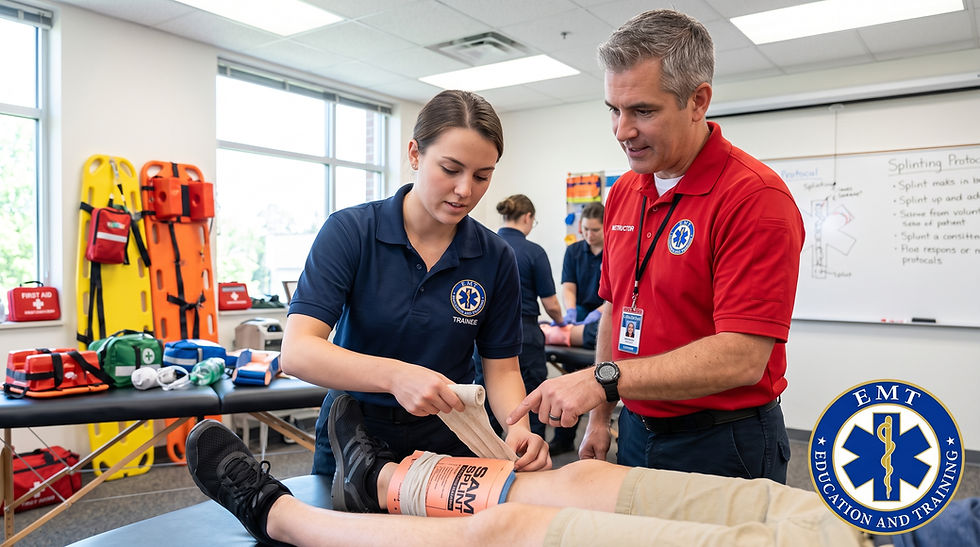
Splinting fractures and controlling bleeding.
Emergency childbirth procedures.
How to Practice:
Rehearse skills repeatedly until muscle memory kicks in.
Use skill checklists to ensure you don’t miss any steps.
Practice with classmates to simulate teamwork under pressure.
Tip:
Video yourself performing skills to self-evaluate and correct mistakes.
9. Take Care of Your Body and Mind
Your physical and mental state on exam day plays a significant role in your performance.
Sleep and Rest:
Get 7–9 hours of quality sleep every night during the final prep week.
Avoid staying up late to cram the night before.
Nutrition and Hydration:
Eat balanced meals to support cognitive function.
Stay hydrated — even mild dehydration can impair focus.
Stress Management:
Practice deep breathing, meditation, or mindfulness techniques.
Visualize success and approach the exam with confidence.
Test-Day Preparation:
Arrive early, bring necessary documents, and plan your route in advance.
Use positive affirmations to stay calm under pressure.
10. Learn from Others and Join Study Communities
One of the fastest ways to improve is by learning from people who have already passed the EMT exam.
Join Study Groups:
Discuss complex topics, quiz each other, and share resources.
Explaining concepts to others reinforces your understanding.
Online Forums and Communities:
Platforms like Reddit and Facebook groups offer tips, advice, and peer support.
Seek Mentorship:
Talk to current EMTs about their exam experience.
Learn from their mistakes and replicate their strategies.
Why This Helps:
Shared knowledge accelerates learning.
Supportive communities keep you motivated and accountable.
FAQs
How do I prepare for EMT school?
The best way to prepare for EMT school is to get familiar with medical terminology, basic anatomy, and how to study effectively before class starts. Students who spend even a few weeks reviewing these areas ahead of time report feeling less overwhelmed during the first unit, since EMT programs move fast and build on material quickly. A structured pre-course, like our EMT Prep Course, is built specifically to cover this ground before training starts.
What should I study before EMT class starts?
Focus on three areas before your first day: basic anatomy and body systems, common medical terminology, and how to read and interpret vital signs. You don't need to master these topics, just get comfortable enough that they're not brand new when your instructor introduces them. Reviewing a body systems overview and a medical terminology glossary is enough to start.
What is EMT school actually like?
EMT school is fast-paced, hands-on, and heavier on memorization than most students expect. Classes combine lecture time with skills practice, like patient assessment, splinting, and airway management, and most programs test both written knowledge and practical skills before certification. Depending on the course format, you'll spend anywhere from a few weeks to a full semester in class, with regular quizzes along the way.
How long does EMT school take?
EMT school length depends on the course format. An accelerated course can be completed in a matter of weeks with full-day sessions several times a week, while a standard or hybrid course spread across evenings or weekends can take a full semester. Our Accelerated EMT Course runs Monday, Wednesday, and Friday from 8am to 3pm for students who want to finish quickly and get into the field.
Is EMT school hard for beginners with no medical background?
EMT school is manageable for beginners, but it does require consistent study habits since the material moves quickly. Students with no prior medical background succeed regularly, the key is staying ahead of the material rather than trying to catch up after falling behind. Building a study routine before class starts makes a bigger difference than any prior medical knowledge.
What topics are covered in EMT school?
EMT programs generally cover patient assessment, airway management, trauma care, medical emergencies, pharmacology basics, CPR and AED use, splinting and bandaging, and ambulance operations. Most courses also include ride-along or clinical hours to apply these skills in real settings. Our EMT Prep Course breaks down 18 of these subject areas in advance, with a video and downloadable materials for each.
Do I need to study medical terminology before EMT school?
You don't need to be fluent in medical terminology, but a working knowledge of common terms helps you keep pace with lectures instead of spending class time looking words up. Terms related to anatomy, injuries, and vital signs come up constantly from day one.
Is EMT school physically demanding?
Yes, EMT training includes physical skills practice like lifting, carrying, kneeling, and performing CPR, so a reasonable level of physical fitness helps. You don't need to be an athlete, but you should be comfortable with hands-on, physically active learning.
What should I bring on the first day of EMT school?
Most programs expect students to bring a stethoscope, a watch with a second hand, a notebook, and comfortable clothing suited for hands-on skills practice. Your specific program will typically send a supply list before your start date, so confirm with your school directly.
Do I need CPR certification before EMT school?
Some programs require current CPR certification before day one, while others include it as part of the course. Check your specific program's requirements ahead of time so it doesn't hold up your enrollment.
Can I work while attending EMT school?
Many students work while attending EMT school, especially with evening, weekend, or hybrid course formats. Accelerated full-day courses are harder to combine with a regular work schedule, so course format matters if you need to keep working during training.
What tips help students succeed in EMT school?
The students who do best in EMT school study a little every day instead of cramming, practice skills outside of class time, and treat the pre-course material seriously instead of skipping it. Consistency matters more than intensity. Getting comfortable with how you study, not just what you study, makes the biggest difference once the course workload picks up.
What should I expect in my first week of EMT school?
Expect a mix of orientation, foundational lectures, and your first look at hands-on skills like taking vital signs. The first week is usually less intense than the weeks that follow, so it's a good time to lock in a study rhythm before the pace increases.
Build Confidence Through Smart Preparation
Passing the EMT exam isn’t just about intelligence — it’s about strategy, discipline, and consistent effort. By following these ten study tips, you’ll walk into your exam with confidence, knowing you’ve done everything possible to succeed.
Remember, your EMT journey doesn’t end with the exam — it’s the beginning of a rewarding career in emergency care. To explore accredited training programs that can help you take that first step, check out Online EMT Schools in California and start building your future today.


Comments