

How to Choose the Best EMT Refresher Course Based on Your State’s Requirements

Choosing the Best EMT Refresher Course depends on more than just cost or convenience. Each state has different renewal requirements, skills expectations, continuing education limits, and rules for online vs. in-person training. A refresher course that works perfectly in one state may not meet the standards of another. EMTs also have varying backgrounds - some are actively working, others are returning after time away, and some need highly structured support to rebuild foundational knowledge.
This guide explains how refresher courses differ, which formats your state accepts, how CE hour requirements affect your choice, and what to look for in a high-quality refresher program. You’ll also find links to long-form EMT education resources, preparation tools, and training pathways that help ensure you’re ready for renewal anywhere in the country.
What Defines the Best EMT Refresher Course?
A high-quality EMT refresher course must meet the national education standards while aligning with state-specific rules. The best courses typically include:
CAPCE accreditation or state approval
Structured NCCP-aligned content
Clear skills verification options
Up-to-date airway, trauma, and medical modules
Flexible scheduling
Strong student support
But even if a course is well-designed, it must still match your state’s acceptance rules. For example:
Some states accept fully online refreshers
Some require in-person skills
Some accept virtual skills verification
Some require a single refresher, while others require CE hours instead
Understanding these distinctions is the key to choosing the right course.
Step 1 – Know Your State’s EMT Renewal Requirements
The best EMT refresher course for you starts with understanding your local EMS authority rules.
Does your state accept online refreshers?
Many states accept online didactic training, but not all accept online skills. Confirm whether your state allows:
Online cognitive hours
Virtual psychomotor evaluation
In-person skills only
Hybrid formats
As of this writing, states like California, Florida, Texas, and Colorado are sometimes more flexible, while others - including New York, New Jersey, Ohio, and North Carolina - can be more restrictive.
Does your state require a formal refresher or CE-only renewal?
Some EMTs can renew using CE hours alone. Others must complete a structured refresher course.
Does your state follow NREMT’s NCCP model exactly?
Most do, but a few states add special modules such as pediatric training, cultural competency, or local EMS policy.
Step 2 – Understand NREMT Renewal Requirements (If Applicable)
Even if your state has its own licensing rules, NREMT certification often plays a role in choosing the best EMT refresher course.
NREMT renewal requires:
40 total hours of continuing education
20 hours: National Component
10 hours: Local/State Component
10 hours: Individual Component
A refresher course that covers the National Component is often essential for meeting these hours efficiently.
Do you need verified skills?
NREMT requires skills verification every renewal period, but the format varies:
Some states allow virtual testing
Others require in-person evaluation
Some employers provide skills verification internally
Choosing a refresher that includes instructor-led skills review is helpful if you work independently or need structured practice.
Step 3 – Match Course Format to Your State Requirements
There are three main types of EMT refresher formats:
Online EMT Refresher Courses
This is the most flexible option and often the best EMT refresher course for EMTs who need convenience or self-paced learning.
Pros
Study at home
Works with rotating EMS shifts
Usually more affordable
Accessible anywhere in the U.S.
Ideal for EMTs who already feel confident with hands-on skills
Cons
Some states require additional in-person skills
Must ensure the provider is approved in your state
In-Person EMT Refresher Courses
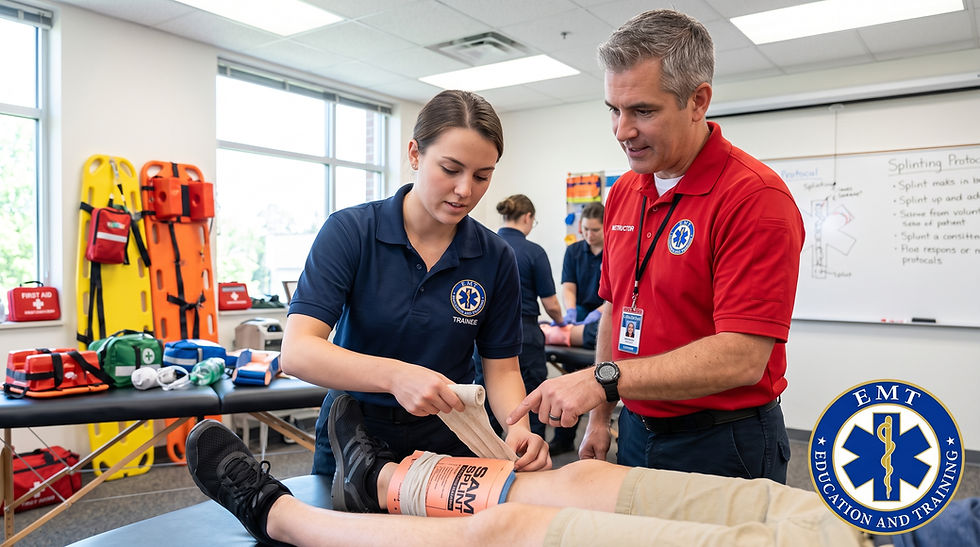
This format is often required when states mandate hands-on skills validation.
Pros
Direct instructor supervision
Immediate feedback on skills
High-fidelity scenarios
Preferred by strict EMS authorities
Cons
Limited availability
Requires travel and fixed schedules
Higher cost
Hybrid or Virtual-Skills EMT Refresher Courses
Hybrid courses combine online education with either:
In-person skills days
Virtual skills testing
Pros
Best balance of flexibility and compliance
Strong option for states that don’t accept fully online refreshers
Good for EMTs wanting instructor engagement
Cons
Virtual skills acceptance varies
Scheduling required for skill assessments
Step 4 – Evaluate Course Content Carefully
The best EMT refresher course must meet national competency standards. Look for programs covering:
Airway, Respiration, Ventilation
Oxygen therapy
Airway adjuncts
BVM ventilation
Suctioning
Cardiology and Resuscitation
CPR updates
AED skills
Arrhythmia basics
Cardiac emergencies
Trauma Care
Hemorrhage control
Shock management
Splinting
Trauma assessments
Medical Emergencies
Diabetic issues
Poisonings
Behavioral emergencies
OB and pediatric modules
EMS Operations
Scene safety
Incident command
Ambulance operations
Mass-casualty incidents
If your refresher course lacks these core domains, it will not meet NREMT or state approval standards.
Step 5 – Verify State Approval and Accreditation
This is where many EMTs unknowingly choose the wrong refresher course.
Make sure the provider is:
CAPCE-accredited
Listed on your state’s EMS-approved provider list
NREMT-aligned
Transparent about skills verification
Beware of:
Low-cost programs with no accreditation
“Instant certificate” refreshers with no educational value
Out-of-state providers not recognized by local EMS jurisdictions
If the accreditation is not correct, your renewal may be rejected.
Step 6 – Check Skills Verification Requirements
Your state determines whether skills must be:
In-person only
Completed virtually
Verified by your agency
Added separately from your refresher course
If you choose a refresher that does not include skills and your state requires it, you will still have to track down a skills evaluator - causing delays or extra cost.
FAQs About Choosing the Best EMT Refresher Course
1. What is the best EMT refresher course for my state?
The best option is one that meets your state’s EMS approval requirements, aligns with NREMT’s NCCP standards, and has a reputation for providing high quality training.
2. Do all states accept online EMT refresher courses?
No. Some require in-person skills or hybrid validation.
3. What if my certification has expired?
You may need a refresher course, CE hours, and potentially NREMT retesting.
4. What happens if I take a course my state doesn’t approve?
Your renewal could be denied, forcing you to take an approved course.
5. Does the best EMT refresher include skills training?
Yes, if your state requires hands-on or virtual psychomotor evaluation, you are best off taking an EMT Refresher course that includes skill testing as well. .
6. Should I prepare before taking a refresher course?
Yes. Many EMTs struggle because their foundational anatomy and A&P knowledge is rusty. Go back and review the basic sciences like Anatomy, physiology, medical terminology, shock, etc.
7. How do I know if a course is accredited?
Verify CAPCE or state approval directly on EMS authority websites.
Choosing the Best EMT Refresher Course requires understanding your state’s rules, your certification status, and whether the program includes the skills and CE components required for renewal. Strengthening your foundational EMT knowledge gives you the confidence to complete any refresher format successfully.
Visit https://www.emteat.com to explore full EMT course training options or our EMT Preparation course if you are preparing to take a full EMT course in the future.
Have questions? Call 310-295-0271. Our team is ready to help you choose the right training path based on your state’s requirements.


Comments